


Why financing disability-inclusive education matters
By Federica Settimi, Inclusion International; Diane Richler, International Disability Alliance (IDA); Rediet Mesfin, Light for the World; Mariana Rudge, Sightsavers; and Valentina Pomatto, Humanity & Inclusion
Investing in inclusion is investing in better education for all
Around the world, 272 million children and young people are currently out of school, with children with disabilities among those most likely to be left behind within education systems. At a time of shrinking aid budgets, increasing humanitarian need and growing pressure on public finances, ensuring that education systems are inclusive is both an urgent equity priority and a smart investment.
Inclusive education is not only about supporting children with disabilities. Education is a fundamental right and a driver of equality, better health and more cohesive societies.When schools are designed for all learners, everyone benefits. Accessible infrastructure helps all students navigate their learning environment, well trained teachers can respond to diverse learning needs, and flexible teaching approaches to improve learning outcomes for all children.
Yet despite growing recognition of the importance of disability-inclusive education, significant gaps remain between commitments and implementation. Closing this gap requires sustained investment, strong accountability and better data. The recent replenishment of the Global Partnership for Education (GPE), alongside ongoing efforts to mobilise resources for Education Cannot Wait (ECW), has placed global education financing in the spotlight. Governments and partners have reaffirmed their commitment to education, but available resources remain far below global needs.
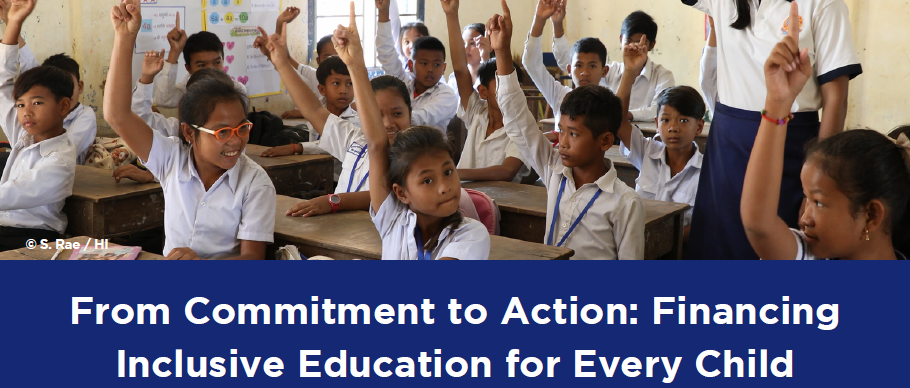
These challenges were the focus of the webinar ‘From Commitment to Action: Financing Inclusive Education for Every Child’, held on 10 September 2026 and jointly convened by the International Disability Alliance (IDA), the International Disability and Development Consortium (IDDC), Inclusion International, Humanity & Inclusion, Light for the World and Sightsavers. Nearly 170 advocates, policymakers and education specialists discussed how education financing can drive meaningful and lasting change for learners with disabilities.
Opening the discussion, Jose Vieira (IDA) warned that despite legislative progress globally, disability-inclusive funding remains critically low at just 0.65% of tracked global education spending. He stressed that commitments alone are not enough, “Policy change will only be effective if first there is investment… but more investment is not enough. We should definitely be looking at where we invest, how we invest, and through which mechanisms.”
From commitments to accountability
The first panel discussed how multilateral institutions and governments are strengthening accountability. Paula Malan (GPE) highlighted more than US$470 billion in domestic education financing commitments made through the GPE replenishment process, including pledges to improve the equity and efficiency of education spend. She noted that these commitments must be implemented and monitored, emphasising that “to drive change to inclusive education systems, it is essential we work together based on mutual accountability”. Polycarp Otieno (UNICEF) reflected on progress towards UNICEF’s commitment to increase disability-inclusive expenditure to 10% by 2030, emphasising that sustainable change depends on embedding inclusion within national budgets, education plans and public finance systems.
Focusing on education in emergencies, Jihane Latrous (ECW) described how disability inclusion is increasingly embedded through a ‘twin-track’ approach that combines mainstream inclusion with targeted interventions. She highlighted that ECW allocated 7% of its 2025 funding to targeted disability interventions and made screening tools mandatory in new crisis programming, declaring: “When a crisis strikes, the systems meant to protect the most marginalized are the first to shatter. Disability inclusion is not an afterthought but a mandate.”
Presenting a national perspective, Ben Lou Poggo (South Sudan Ministry of General Education and Instruction) outlined South Sudan’s strategy for implementing its inclusive education policy and 5% inclusion budget target, while acknowledging the reality that “Without resources it will be very difficult to implement the inclusive education policy.” Laura Stipanovic (UNESCO GEM Report) shared findings from the new Equitable Education Financing Index, which shows that fewer than 1 in 10 countries currently have a strong equity focus in their education financing. She emphasized that “equitable financing is not simply about spending more, but about intentionally distributing resources to those that are most in need.”
The panel highlighted practical tools, including disability financing markers, Washington Group-based disability data collection and UNESCO’s Equitable Financing in Education Index. Speakers stressed that without robust data on who is being reached, how resources are allocated and what outcomes are being achieved, it is difficult to know whether financing is delivering meaningful change for children with disabilities.
The discussion proved particularly timely in light of the recent GPE replenishment. While donor contributions fell short of overall funding ambitions, GPE raised over US$2 billion, partner countries committed more than US $470 billion in domestic education financing and philanthropy, and the private sector committed to contribute a further US$400 million to education.
Why equitable financing matters
Panellists emphasised the importance of evidence in financing decisions. Drawing on findings from costing studies in Zambia, Cameroon, and Senegal, Iain Jones (Sightsavers) demonstrated how robust cost data can help governments and donors understand the investments required to scale inclusive education, explaining that “economic evaluation is a critical element of decision-making on inclusive education… We do it to help debunk the myth that inclusive education is unaffordable.”
Speakers from South Sudan and Palestine shared practical examples from fragile and crisis-affected contexts. Sophia Mohammed Sayed (Light for the World) highlighted the value of long-term partnerships and predictable financing in building sustainable inclusive education systems, including the establishment of South Sudan’s first university disability resource center. Amal Al Barghouthi (Humanity & Inclusion) shared lessons from Palestine, where disability screening tools and community spaces have helped over 2,000 children with disabilities continue learning during conflict.
To close the panel, Mónica Cortés Avilés (Asdown Colombia) shared evidence from Colombia and Niger on why Organisations of Persons with Disabilities (OPDs) and families must directly lead budget planning and monitoring, concluding that “The most efficient inclusive education systems include OPDs not as consultants, but as main actors.”
How to turn commitments into action
As governments, donors and international institutions consider the implications of the recent GPE replenishment and continue mobilising support for ECW, the message remains clear: disability inclusion must be built into education financing from the outset.
Participants highlighted five priorities:
- Adopt a ‘twin-track’ approach: Strengthen general education systems so they are accessible to all learners, while also funding targeted support, such as assistive assistive devices and specialised teacher training
- Embed inclusion into mainstream budgets and planning processes: Disability inclusion should not depend on temporary initiatives or standalone projects; it must be built directly into core public finance and education planning systems
- Track every dollar: Donors and ministries must adopt stronger accountability mechanisms, including disability inclusion markers and disaggregated data tools to ensure resources reach learners with disabilities and improve learning outcomes.
- Fund and partner with local organisations of persons with disabilities: OPDs and families bring essential lived experience and must be directly funded and recognised as equal partners in design, implementation and monitoring
- Turn commitments into results: governments, donors and multilateral organisations must translate financing commitments into tangible improvements for learners with disabilities through stronger accountability, equitable spending and sustained investment in inclusion
These priorities are not new. They align with the Disability Inclusive Education Call to Action, launched at the Transforming Education Summit and endorsed by nearly 200 governments, multilateral organisations, civil society organisations and advocates worldwide. They provide an important framework to ensure efforts to increase education financing do not overlook learners with disabilities.
The choices made in the months ahead will determine whether commitments lead to meaningful change. The GPE replenishment showed both continued global support for education and the financing pressures facing the sector. In this context, disability inclusion cannot be treated as a secondary concern. We know what works to make education systems inclusive. The task now is to ensure that financing, policies and accountability mechanisms deliver for the learners most at risk of being left behind.